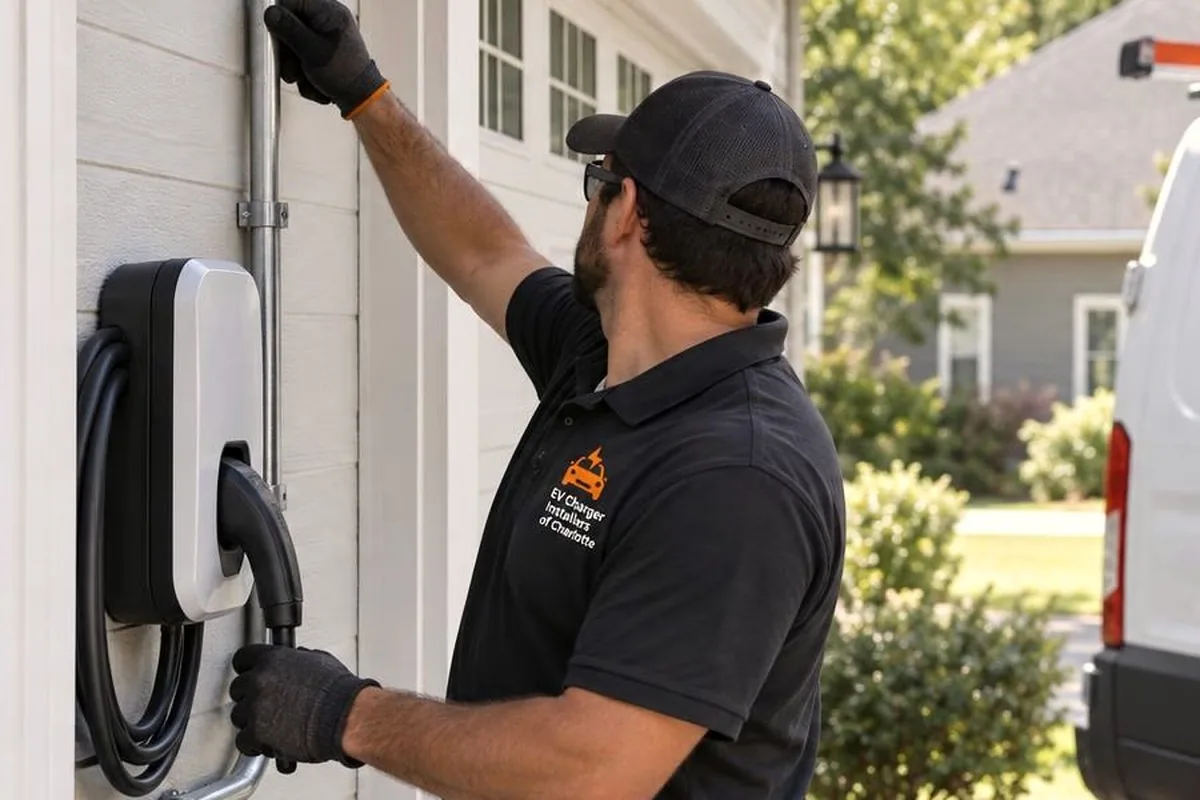
Electrician in gloves fitting a wall-mounted EV charger beside a white garage door

Duke Energy EV Charger Rebate in Raleigh, NC: How the Charger Prep Credit Works for Wake County Homes

Raleigh Homes on Duke Energy Progress Can Claim Up to $1,133

EV Charger Installers of Raleigh put this guide together since no number moves the cost of a home install more than the Duke Energy EV charger rebate in Raleigh, NC. The Duke Energy Charger Prep Credit pays toward the wiring and panel work behind a charger, and it covers Duke Energy Progress customers across Wake County. Below you will find who qualifies, what the credit pays for, the two ways to claim it and the permit it depends on.

Why homeowners choose us:

  • Licensed in North Carolina on every EV circuit we wire
  • Load calculation first before anyone sells you a panel
  • Raleigh permit pulled and the inspection booked
  • Free written estimates itemized for the Duke credit

We are licensed North Carolina electricians, and Duke credit paperwork has been part of our Raleigh charger jobs for many years. Every invoice we write splits labor, materials and permit costs onto separate lines, the layout Duke asks for with a claim. We also confirm your utility on the bill before anyone promises a credit.

Get a FREE EV Charger Installation Quote

Is Your Raleigh Home Eligible for the Duke Energy Charger Prep Credit?

The Duke Energy Charger Prep Credit is a Duke Energy Carolinas and Duke Energy Progress program, so most Raleigh homeowners on Duke can use it. Duke sets out who qualifies in its program terms:

Duke Energy Progress EV Owners Who Qualify

  • An active Duke account at the home. The credit is only for direct Duke customers.
  • You own the house. A single-family home or a townhome qualifies, and renters and condo residents who do not own their unit do not.
  • An EV registered to that address. The car can be fully electric or a plug-in hybrid, owned or leased, and registered with the NC DMV.
  • Licensed work. The installer must hold an electrical license or work for a licensed contractor.
  • A permit you obtain and pay for. The approved permit goes in with your application.
  • Work after May 19, 2022. Upgrades finished before that date do not qualify.

Each EV registered at the address can earn one rebate. Property managers looking to wire an apartment building are pointed to Duke’s commercial credit instead.

In the Triangle, two neighbors can be served by different utilities, and nearby Apex runs its own. Check your own bill before counting on the credit. We read it at the estimate for the same reason, so no quote quietly assumes money that will not arrive.

What the Duke Energy Rebate Pays For, and What Raleigh Homeowners Still Cover

Duke caps the credit at $1,133, and it pays only for make-ready work behind the charger. The table sorts a typical Raleigh job into covered and uncovered parts:

Part of the jobCounts toward the Duke credit?
Wire and conduit from the panel to the chargerYes
240-volt outlet for a plug-in chargerYes
New breaker for the charger circuitYes
Panel upgrade made for the chargerYes
The charger, Tesla or any other brandNo
Mounting and commissioning the chargerNo
City of Raleigh permit feesNo
Upgrades on Duke’s side of the meterNo

The amount varies with your qualifying costs, so a short run to a 14-50 outlet earns less than a long run plus panel work. Rarely, Duke’s own feed to the panel is too small and needs Duke’s Line Extension Plan, and that cost is excluded. Most Raleigh installs cost $892 to $1,638 before the credit, with the charger bought separately.

Panel work is where the credit does the most good. A Raleigh home that needs an upgrade before a Tesla charger installation or any other charger can see a large share of that cost covered, up to the $1,133 cap. Our EV charger panel upgrade page explains when an upgrade is actually needed, since most newer Raleigh homes have room on a 200-amp panel.

Duke Customer Credit or Contractor Credit: Picking Your Route in Raleigh

Duke runs two claim routes, and which one fits comes down to whether an electrician is already hired.

The Customer Credit Option suits most Raleigh homeowners. You choose the contractor, the work gets done and permitted, and you submit the paid invoice with your application. Duke reviews it and emails a confirmation, and a check from Duke’s vendor, Blackhawk, arrives by mail within 30 days. Progress can be followed online after you apply.

With the Contractor Credit Option, Duke helps match you with a contractor. The credit is then taken off that contractor’s final bill, so no check is mailed.

We work through the Customer Credit Option, so you keep the choice of electrician and the check comes to you. Our job is to make the paperwork easy to file. The invoice lists the contractor’s name, address and phone, splits materials from labor, and puts the permit cost on its own line, exactly as Duke’s application asks. Either way, the application has to go in within 120 days of the later of your last invoice or your EV registration.

The Raleigh Permit the Duke Energy Rebate Depends On

A charger circuit in Raleigh needs a city electrical permit, and Duke will not pay without a copy of it. The City of Raleigh lists interior vehicle charging stations among the work its Permit and Development Portal accepts.

Filing the Raleigh EV Charger Permit

  • We apply through the portal as your contractor, so you skip the Owner Exemption Affidavit a do-it-yourself homeowner would need.
  • Fees pass through on their own line. The city collects a plan review fee before review and the permit fee at issue.
  • An inspector checks the finished circuit on a later visit, and we meet them.
  • The approved permit goes into your claim file next to the itemized invoice.

Questions about a specific permit go to the city’s permit helpline at 919-996-2500. Unpermitted installs disqualify the credit and can complicate an insurance claim later.

Why Free Installation Promises Fall Short on the Duke Energy Rebate in Raleigh

Some Triangle installers tell homeowners the Duke credit can make a charger install free. The math rarely works, because the credit never covers three real costs: the charger, mounting it and the permit fee.

EV Charger Rebate NC Rules: What the Credit Leaves Out

A Level 2 charger alone runs $500 to $800, and the credit pays none of it. Mounting and commissioning sit outside the credit too, and so do the City of Raleigh fees. A homeowner with a short, simple install may see most of the wiring covered, yet still pays for the charger and the permit.

The federal 30C credit for home chargers also ended for equipment placed in service after June 30, 2026. For Raleigh homeowners on Duke Energy Progress, the Charger Prep Credit is now the incentive worth planning around. Duke Energy Progress customers can also switch to EV Overnight Advantage, a rate that discounts charging from 11 at night to 5 in the morning. A scheduled charge on that rate keeps running costs down long after the install is paid off. A Wall Connector and most smart chargers can be set to start on their own.

Duke Energy EV Charger Rebate FAQs: Raleigh, NC

How much is the Duke Energy EV charger rebate in Raleigh?

Duke Energy Progress customers can claim up to $1,133. The amount depends on qualifying costs such as wiring, outlets and panel work.

Does the Duke credit pay for my charger?

The credit covers the wiring, outlet, breaker and panel work behind the charger. The charger itself, mounting it and permit fees are not covered.

Can I claim the Duke credit for a charger already installed?

Work finished within the last 120 days can still be claimed through the Customer Credit Option, as long as it was permitted. Work older than 120 days is not eligible.

Do I qualify if I rent my Raleigh home?

A Raleigh renter does not qualify, and neither does a condo resident who does not own the unit. A property manager can look at Duke's commercial credit for the building.

Does the charger have to be in my garage?

Duke allows the charger anywhere as long as it connects to the home's own panel. A carport post or an exterior wall both qualify.

What do I send Duke with the application?

Send the completed application, your EV registration showing the Duke address, a paid itemized invoice and a copy of the approved permit. The invoice needs materials, labor and permit costs on separate lines.

Do I have to own the EV?

The EV can be owned or leased, and it must be registered to the Duke account address. A charger installed with no EV at the home does not qualify.

EV Charger Installers of Raleigh serves Raleigh and Wake County.

Get a Free EV Charger Installation Quote in Raleigh, NC

(919) 858-2680 Get a Free Quote